

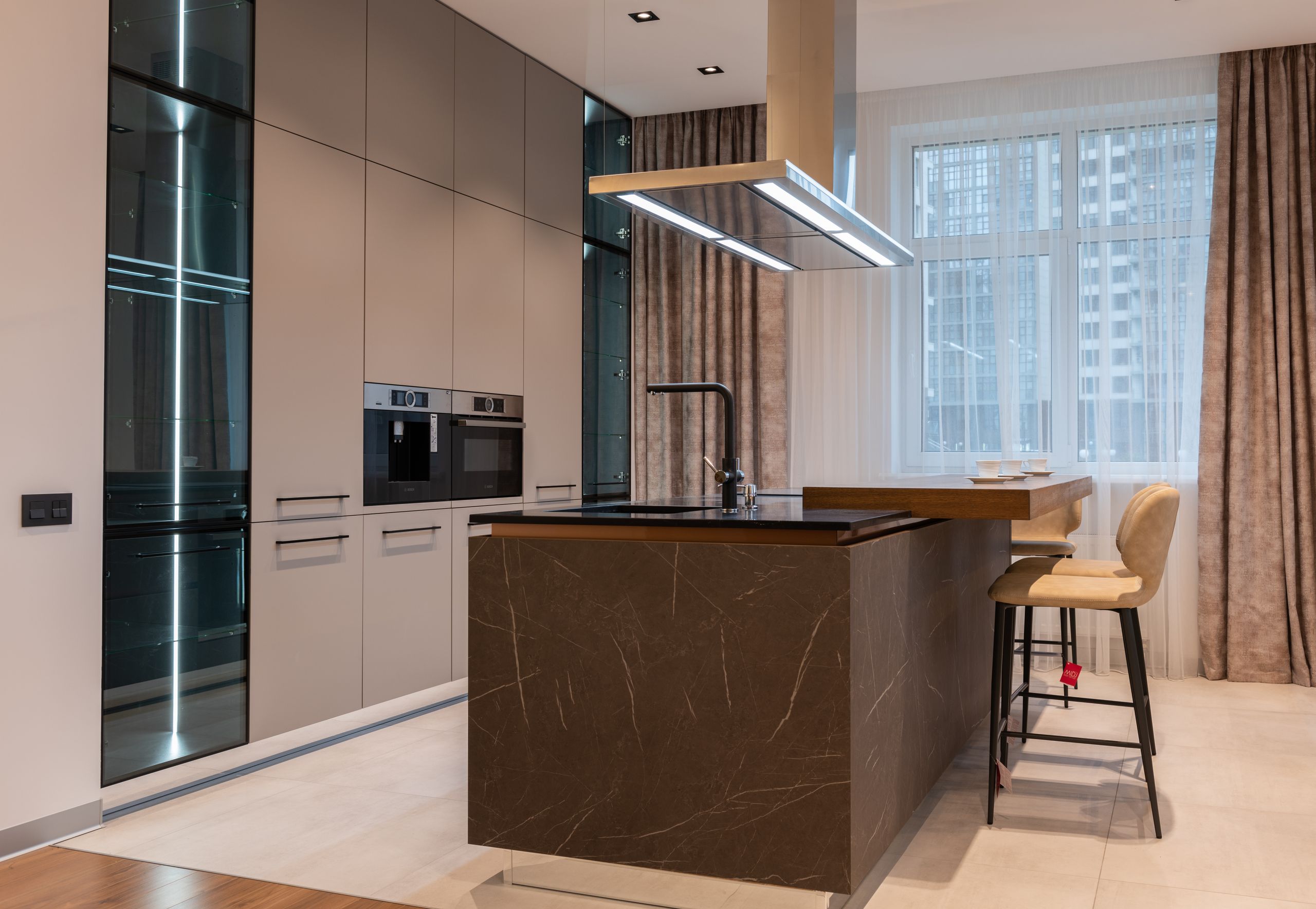
Kitchen windows can have a surprisingly strong effect on how the entire room feels. They bring in natural light, offer views outside, and can also become an opportunity to introduce color, texture, and softness into a space filled with hard surfaces.
That is where thoughtful kitchen curtain ideas can make a difference. The right treatment does more than cover glass. It can provide privacy, filter harsh sunlight, complement cabinets, and make a kitchen feel more finished without overwhelming the design.
Modern kitchen curtains are not limited to one look. Linen café curtains, soft sheers, tailored Roman shades, subtle stripes, natural fabrics, and even floor-length panels can all work when their proportions and placement suit the room.
The most useful approach is to consider the window first and the trend second. A beautiful curtain that blocks needed daylight or becomes difficult to maintain may not be the right choice for an active kitchen.
Why Kitchen Curtains Can Look Modern Again
Kitchen curtains have sometimes been associated with heavily decorated interiors, but that does not mean they have to look traditional.
Today’s modern kitchen curtain ideas often focus on simple shapes, natural textures, controlled patterns, and colors that connect with the rest of the room. The result can feel relaxed and contemporary without making the kitchen look overly decorated.
Fabric also adds something valuable to a kitchen: softness.
Cabinet doors, stone countertops, tile backsplashes, stainless-steel appliances, and metal fixtures can create a lot of visual structure. A textile window treatment introduces a different texture and can make the room feel more comfortable.
The key is proportion. A small kitchen window may look better with a compact café curtain or Roman shade, while a large window can handle wider panels or a more substantial pattern.
Here’s the thing: a modern curtain does not necessarily have to be plain. A small-scale print, muted stripe, or natural woven texture can work beautifully when the rest of the kitchen remains balanced.
10 Modern Kitchen Curtain Ideas for Stylish and Functional Windows
1. Relaxed Linen Café Curtains
Café curtains are one of the most practical choices for smaller kitchen windows, especially those positioned above a sink.
They normally cover only part of the window, allowing daylight to enter through the upper section while providing privacy across the lower portion. This makes them useful when you want some coverage without making the entire window feel closed off.
Linen and linen-blend fabrics are especially suitable when you want a relaxed appearance. Their natural texture can complement wood cabinets, stone surfaces, painted cabinetry, and other organic materials.
For a more contemporary result, keep the construction simple. A clean rod and uncomplicated fabric can make the treatment feel current without losing the charm associated with café curtains.
Neutral colors such as cream, oatmeal, beige, and soft gray are easy to coordinate, while muted green or blue can introduce a gentle accent.
Best for: Small windows, sink windows, cottage-inspired kitchens, and relaxed contemporary spaces.
2. Soft Sheer Curtains for a Light-Filled Kitchen
If natural light is one of the best features of your kitchen, sheer curtains can help preserve it.
Lightweight sheers filter incoming sunlight rather than blocking it completely. This creates a softer glow and can reduce the harsh appearance of direct sunlight while maintaining an airy feeling.
White and ivory are classic choices, but warmer neutrals can make a kitchen feel more comfortable. A slightly textured sheer can add interest without introducing a strong pattern.
There is one practical point to consider: sheer fabric offers limited privacy at night when the interior lights are on. If nighttime privacy matters, pair the sheer with another adjustable treatment.
This style works particularly well in kitchens connected to dining rooms or living spaces because the lightweight fabric can visually connect the areas.
Best for: Bright kitchens, large windows, open-plan homes, and spaces where daylight is a priority.
3. Tailored Roman Shades With Subtle Texture
Roman shades offer a cleaner and more structured alternative to traditional curtain panels.
They can be especially effective in smaller kitchens where long fabric panels would interfere with cabinets, counters, or nearby furniture.
A neutral Roman shade with subtle texture can introduce warmth without creating visual clutter. Linen-look fabrics, woven materials, and understated patterns are useful options.
Roman shades also give you more control over privacy and sunlight. You can raise the shade when you want more daylight and lower it when the room needs additional coverage.
For a modern appearance, avoid excessive decorative details. Simple construction usually works best with contemporary cabinetry and clean architectural lines.
The shade should also relate to the rest of the kitchen. If your room already has several textures or patterns, a quiet neutral shade can provide balance.
Best for: Minimalist kitchens, small-to-medium windows, sink areas, and tailored interiors.
4. Small-Scale Stripes for Subtle Pattern
Stripes can make a kitchen window more interesting without overwhelming the room.
The safest approach is to keep the scale controlled. Narrow or medium-width stripes are generally easier to integrate than very large, dramatic designs.
A cream-and-gray stripe can complement a neutral kitchen, while muted blue, green, or charcoal can provide more contrast.
Vertical stripes may also draw the eye upward, which can help emphasize the height of a window.
Stripes are particularly useful when you want some pattern but do not want the curtain to become the main feature of the room.
If your backsplash, flooring, or upholstery already contains bold patterns, keep the curtain stripe relatively subtle.
Best for: Transitional kitchens, modern farmhouse spaces, neutral interiors, and rooms that need a restrained decorative detail.
5. Minimal Curtains in a Statement Color
A simple curtain does not have to disappear into the background.
In a mostly neutral kitchen, a curtain in a carefully selected accent color can become a useful design feature. Olive green, sage, deep blue, terracotta, and muted mustard are examples of colors that can add personality without making the room feel excessively bright.
The trick is to repeat the color somewhere else in the kitchen.
You might echo the curtain color through a runner, artwork, dining chair, small appliance, or decorative accessory. The repetition makes the color feel intentional rather than random.
Keep the curtain design relatively simple if the color is strong. A bold shade already provides visual interest, so additional decorative details may not be necessary.
Best for: Neutral kitchens, contemporary interiors, and rooms that need a controlled color accent.
6. Café Curtains With a Modern Pattern
A café curtain does not have to be plain.
Small checks, restrained botanical prints, simple geometric patterns, and delicate abstract designs can give this classic treatment a fresher appearance.
Because the curtain only covers part of the window, you can experiment with pattern without making it dominate the entire kitchen.
Color is particularly important here. A modern pattern does not necessarily need bright colors. Muted blue, sage, cream, charcoal, or earthy tones can create a more sophisticated appearance.
Traditional floral patterns can work as well. What makes a floral curtain feel contemporary is often the combination of scale, color, fabric, and surrounding décor rather than the pattern category itself.
That means you do not have to avoid familiar design elements simply because they have been used in traditional kitchens.
Best for: Small windows, cottage kitchens, modern farmhouse interiors, and spaces that need controlled pattern.
7. Floor-Length Curtains for Large Kitchen Windows
Long curtains can be surprisingly effective in kitchens with large windows.
They can frame wide openings, French doors, bay windows, or kitchen areas connected to dining and living spaces. In an open-plan home, they can also help create a visual relationship between different zones.
This option requires more planning than a small café curtain. The fabric should not interfere with doors, appliances, counters, or areas where people regularly walk.
A simple linen or cotton panel can provide softness without appearing overly formal. Neutral colors are easy to coordinate, while a subtle pattern can add personality to a large opening.
Large windows can usually handle greater visual scale. A fabric pattern that might overwhelm a small sink window can look appropriately balanced across a much wider opening.
Best for: Large windows, French doors, open-plan kitchens, dining areas, and spacious rooms.
8. Natural-Tone Curtains for a Warm Minimalist Kitchen
Natural colors can make a kitchen window feel integrated rather than decorative.
Oatmeal, cream, beige, taupe, warm white, and natural flax tones work especially well with wood, stone, cream cabinetry, and other warm materials.
Because the colors are quiet, texture becomes more important. A linen weave, slub texture, or woven finish can prevent the treatment from looking flat.
This approach is useful for homeowners who want a minimalist kitchen without making the room feel cold.
The curtain does not have to stand out. Sometimes its role is simply to soften the transition between the window and the surrounding materials.
Best for: Warm minimalist kitchens, natural-material interiors, Scandinavian-inspired spaces, and neutral kitchens.
9. Contrast-Border or Trimmed Curtains
A narrow contrasting border can give a simple curtain a more tailored appearance.
For example, a dark border on a light curtain can connect with black cabinet handles, lighting fixtures, or other hardware. A muted blue edge might relate to a backsplash or nearby seating.
The effect is subtle, but it can make an ordinary curtain feel more intentional.
The border should remain relatively restrained. If the curtain already has a strong pattern, adding heavy trim may create too much visual activity.
This idea works especially well when the kitchen already has repeated accent colors or finishes that the curtain can reference.
Best for: Transitional kitchens, tailored interiors, and kitchens with strong hardware or accent colors.
10. Layered Kitchen Window Treatments
Layering can provide greater flexibility when a single treatment cannot meet every need.
For example, sheer curtains can filter daylight while a Roman shade provides additional privacy. A café curtain can also be combined with an upper treatment in a larger window.
The purpose of layering should be clear.
If every layer has a different pattern, color, or decorative feature, the window may become unnecessarily busy. Instead, use differences in texture or function to create a more controlled combination.
A smooth Roman shade with a lightly textured curtain can work well. So can a quiet solid curtain paired with a subtly patterned shade.
The goal is flexibility, not decoration for its own sake.
Best for: Kitchens with changing light conditions, large windows, privacy concerns, and homeowners who want adjustable coverage.
How to Choose Kitchen Curtains for Your Space
Finding attractive kitchen window curtain ideas is only the first step. The window’s location and the kitchen’s everyday use should influence your final decision.
Consider the Window’s Location
Start by asking where the window sits.
A sink window needs different treatment from a large window beside a dining table. A window next to a cooking area may need a more practical and easy-to-clean fabric.
For smaller windows, compact treatments usually work well because they preserve visual space. Large windows provide more flexibility with curtain length, pattern, and layering.
Choose a Practical Fabric
Kitchens can expose fabrics to dust, moisture, odors, and occasional splashes.
That makes maintenance worth considering before you choose a material.
Washable or easy-care fabrics can be useful around sinks and food-preparation areas. Linen blends, cotton, and lightweight fabrics may provide attractive texture while remaining relatively practical depending on their care requirements.
Always check the manufacturer’s care instructions for the specific fabric.
Think About Light and Privacy
Consider how much daylight enters the room and when privacy is most important.
A kitchen that receives strong afternoon sunlight may benefit from a light-filtering treatment. A window facing a neighboring home may require greater coverage.
Café curtains can provide partial privacy while leaving the upper portion of the window uncovered. Roman shades can offer more complete coverage when needed.
The right choice depends on how the room is actually used throughout the day.
Match the Curtain to the Kitchen
Do not choose curtains based only on the window frame.
Look at the cabinets, backsplash, countertops, flooring, lighting, hardware, furniture, and nearby accessories.
If the kitchen already contains several strong patterns, a solid curtain may create balance. If the room is mostly neutral, a small print or accent color can provide visual interest.
The curtain should feel connected to the overall space.
Kitchen Curtain Mistakes That Can Make a Room Look Dated
Even attractive curtains can feel wrong when their scale or placement does not suit the kitchen.
Choosing Too Much Fabric
Large amounts of heavy fabric can overwhelm a small kitchen window.
A simpler treatment may provide the same privacy or decorative effect without making the area feel crowded.
Before choosing a curtain, consider how much surrounding wall and cabinet space is available.
Ignoring Maintenance
Kitchen curtains are exposed to conditions that bedroom curtains usually are not.
A fabric that requires delicate cleaning may become inconvenient when positioned near a sink or cooking area.
Think about maintenance before focusing only on appearance.
Using Competing Patterns
Pattern can add character, but too many strong patterns can make the room feel visually unsettled.
If the backsplash is bold, the floor has a noticeable design, and the kitchen already contains patterned textiles, a quieter curtain may create a better balance.
Blocking Useful Natural Light
Heavy curtains can reduce the amount of daylight entering the room.
That may be unnecessary if privacy is only needed at certain times. Adjustable treatments can provide a better balance between coverage and natural light.
Which Kitchen Curtain Style Fits Your Window?
Different treatments solve different problems. This quick comparison can help narrow the options:
| Style | Best For | Main Benefit | Potential Limitation |
| Café curtains | Sink and small windows | Privacy while keeping upper glass open | Less overall coverage |
| Sheer curtains | Bright kitchens | Softens and filters daylight | Limited nighttime privacy |
| Roman shades | Minimal or tailored kitchens | Clean, structured appearance | Can feel more formal |
| Long curtain panels | Large windows and open-plan areas | Adds height and visual framing | Requires more surrounding space |
| Woven wood shades | Warm, natural kitchens | Adds texture and depth | Provides less fabric softness |
There is no universal winner.
A café curtain may make sense for a small sink window, while a Roman shade may be more suitable where you want a clean, tailored appearance. A large kitchen connected to a dining area may have enough space for full-length panels.
The window itself should guide the decision.
Frequently Asked Questions About Kitchen Curtains
Are kitchen curtains still in style?
Yes. Kitchen curtains remain a practical way to add softness, privacy, light control, and visual interest. Modern results usually come from simple silhouettes, appropriate proportions, natural textures, and colors that work with the surrounding kitchen.
What type of curtains look modern in a kitchen?
Simple linen curtains, lightweight sheers, tailored Roman shades, restrained stripes, natural-tone panels, and carefully selected café curtains can all work in modern kitchens.
The surrounding room matters just as much as the curtain.
Are café curtains outdated?
Café curtains are not automatically outdated. Their appearance depends on the fabric, pattern, color, hardware, and styling. A simple linen café curtain can look very different from a heavily decorated traditional version.
What works best above a kitchen sink?
Café curtains and Roman shades are practical choices for many sink windows because they provide privacy and light control without requiring long amounts of fabric.
Washable or easy-care materials can also make sense in this location.
What colors work well for kitchen curtains?
Cream, oatmeal, beige, taupe, soft gray, and warm white are versatile choices. Muted green, blue, terracotta, or mustard can add more personality.
Rather than matching the cabinets exactly, consider choosing a color that complements another element in the kitchen.
Should kitchen curtains match the cabinets?
They do not need to match exactly.
A better approach is to coordinate with the room’s broader palette. The curtain could complement the backsplash, repeat an accent color, relate to the countertop, or echo hardware.
Should you use long curtains in a kitchen?
Long curtains can work well with large windows, French doors, and open-plan kitchens. They may be less practical directly beside sinks, counters, or busy work areas.
How often should kitchen curtains be cleaned?
Cleaning frequency depends on the fabric and its location. Curtains close to cooking and sink areas may need more frequent cleaning than those positioned farther away.
Always follow the care instructions for the particular material.
Final Thoughts
The best kitchen curtain ideas are not necessarily the most complicated ones. A well-proportioned café curtain, soft sheer, textured Roman shade, or simple panel can completely change the character of a kitchen window.
The important part is choosing a treatment that fits the space.
Think about the size of the window, the amount of natural light, privacy requirements, fabric maintenance, and the colors and textures already present in the kitchen. These details usually matter more than following a single decorating trend.
A modern kitchen can include traditional elements. It can also include pattern, texture, and softness without losing its contemporary character.
When the curtain supports the rest of the room instead of competing with it, the window becomes a natural part of the design.
