




Standing in front of a wall of paint chips is one of the most stressful parts of any home project. How to Choose Paint Colors There are
thousands of shades, many look almost identical, and a wrong choice means buying more paint and repeating the work.
The good news: choosing paint colors is a process, not a gamble. How to Choose Paint Colors To choose a paint color, start with your room’s light, size, and fixed elements (floors, cabinets, tile), decide on the mood you want, narrow your list to two or three shades with the right undertone, then test large samples on your own walls at different times of day.
This guide walks you through that process in nine steps. How to Choose Paint Colors You will also find advice for exterior colors, front doors, accent walls, white paint, and cabinets, plus tables, examples, and answers to common questions.
Quick Summary: How to Choose Paint Colors in 9 Steps
- Start with what you already have (rugs, art, flooring, cabinets).
- Decide the mood you want in the room.
- Understand undertones.
- Check the natural and artificial light.
- Match color to room size and shape.
- Pick a color scheme using the color wheel.
- Balance your colors with the 60-30-10 rule.
- Create flow from room to room.
- Test samples before you commit.
Step 1: Start With What You Already Have
The easiest way to choose paint colors is to begin with things you cannot or will not change. This stops you from picking a color that fights with your home.
Pull colors from rugs, art, and fabrics
Look at the items you love most: a rug, a painting, a cushion, a curtain. They often contain colors you are already drawn to. Pick one or two colors from them and use a softer or deeper version on the walls.
Identify fixed elements
Fixed elements are the features that will stay as they are: flooring, kitchen cabinets, countertops, tile, a brick or stone fireplace, and built-in shelving. Your wall color has to work with all of them.
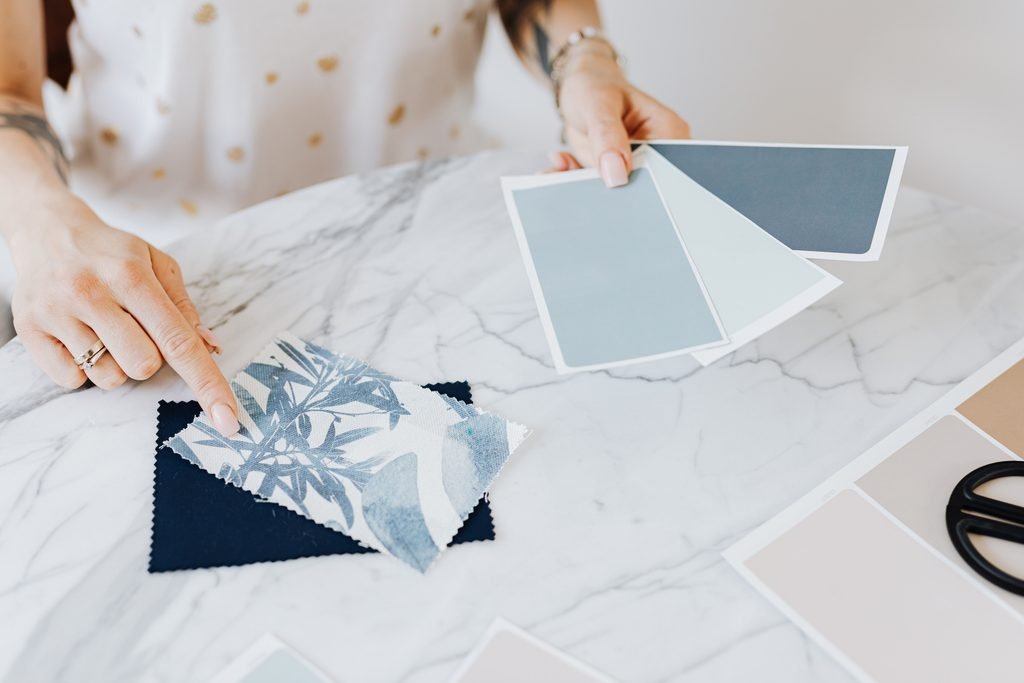
Match the undertones of fixed elements
Every material has an undertone, a subtle hint of another color underneath. How to Choose Paint Colors Red-toned wood, yellow-toned travertine, and gray stone all pull paint in different directions. The table below shows how to pair them.
| Fixed element | Undertone to check | Paint colors that usually work |
|---|---|---|
| Red or orange-toned wood | Warm red | Warm creams, sage green, soft taupe |
| Gray stone or tile | Cool gray | Cool whites, soft blue, greige |
| Beige or travertine tile | Warm yellow | Warm whites, light tan, olive |
| Dark espresso floors | Neutral to cool | Soft white, light gray, pale sage |
| White cabinets | Clean or warm | A white with the same undertone |
Step 2: Decide the Mood You Want
Color affects how a room feels. Before you look at swatches, decide what you want the space to do for you.
Warm colors for social spaces
Yellows, terracotta, warm reds, and creamy neutrals feel welcoming. How to Choose Paint Colors They suit living rooms, dining rooms, and kitchens, where people gather.
Cool colors for restful spaces
Soft blues, greens, and cool grays feel calm. They are popular in bedrooms, bathrooms, and home offices.
Neutrals for flexibility
Whites, beiges, and grays work almost anywhere and make furniture and art stand out. They are a safe base if you like to change your decor often.
A note on color psychology: these associations are general guides, not strict rules. How to Choose Paint Colors Your own taste, your furniture, and your light matter more than any chart.
Step 3: Understand Undertones (Where Most People Go Wrong)
If you have ever painted a room “gray” and ended up with a blue or purple wall, undertones are the reason.
What are undertones?
An undertone is the faint secondary color hidden inside a paint. How to Choose Paint Colors A white may lean yellow, pink, or blue. A gray may lean green, blue, or purple. Undertones are easy to miss on a small chip but obvious on a full wall.
How to spot warm, cool, and neutral undertones
- Hold the chip against a sheet of pure white paper. The undertone shows more clearly.
- Compare it with other chips on the same strip or in the same family.
- Look at the darkest shade on the strip. It reveals what the lighter ones are leaning toward.
Why the same “gray” can look blue, purple, or green
Large areas of paint reflect more light and amplify the undertone. Nearby colors (green trees outside, a red sofa) also change how it looks.
| Color family | Possible undertones | Watch out for |
|---|---|---|
| White | Yellow, pink, blue | Can look stark or dingy beside the wrong floor |
| Gray | Blue, green, purple | Turns cold in north-facing rooms |
| Beige | Pink, yellow, green | Can look flat or dated |
| Greige | Warm or cool | Test in daylight and under lamps |
Step 4: Consider Natural and Artificial Light
Paint changes color throughout the day. How to Choose Paint Colors A shade that looks perfect at noon can look flat or muddy at 7 p.m.
How room direction changes paint color
In the US and UK (both in the northern hemisphere), light follows a predictable pattern:
| Room direction | Light quality | Best approach |
|---|---|---|
| North-facing | Cool and dim | Use warm tones; avoid cool grays |
| South-facing | Bright and warm | Most colors work; cooler tones balance glare |
| East-facing | Warm in the morning, cooler later | Test morning and afternoon |
| West-facing | Cooler by day, golden at sunset | Watch for color shifts in the evening |
Bulb types and color temperature
Warm white bulbs add a yellow glow that can make cool colors look dull. How to Choose Paint Colors Daylight bulbs are bluer and can make warm colors look harsh. Check your paint under the bulbs you actually use.
Why you should not pick a color in the store
Store lighting is bright and uniform. Your home is not. Always judge the color in the room where it will live.
Step 5: Match Color to Room Size and Shape
Color can change how big, tall, or wide a room feels.
Small rooms
Light colors reflect more light and make a room feel more open. How to Choose Paint Colors But a small room does not have to be pale. A deep color can make it feel cozy and intentional, especially in a bedroom or powder room.
Large rooms
Darker or warmer colors make big rooms feel more intimate and bring walls visually closer.
Narrow rooms
Paint the short walls a slightly darker shade and the long walls a lighter one to make the room feel wider.
Ceiling height
A light ceiling feels higher. A darker ceiling feels lower and cozier.
A quick word on LRV
Light Reflectance Value (LRV) is a number from 0 (black) to 100 (pure white) printed on most paint chips. How to Choose Paint Colors It tells you how much light a color reflects.
| LRV range | What it means | Effect in a room |
|---|---|---|
| 70-100 | High reflectance | Bright, open, airy |
| 40-69 | Medium reflectance | Balanced, easy to live with |
| 0-39 | Low reflectance | Dramatic, cozy, absorbs light |
If your room has little natural light, a higher LRV usually helps. Different paint brands may measure LRV slightly differently, so treat it as a guide.
Step 6: Choose a Color Scheme Using the Color Wheel
The color wheel helps you combine shades that look good together.
Monochromatic
Different shades and tints of a single color. How to Choose Paint Colors It is calm and cohesive, and it is the easiest scheme to get right.
Analogous
Colors that sit next to each other on the wheel, such as blue, blue-green, and green. How to Choose Paint Colors The result is soft and harmonious.
Complementary
Colors on opposite sides of the wheel, like blue and orange. How to Choose Paint Colors Bold and energetic, but best used with one color dominant.
Triadic
Three colors spaced evenly around the wheel, such as red, yellow, and blue. Playful and lively, but harder to balance.

| Scheme | Feel | Best for | Difficulty |
|---|---|---|---|
| Monochromatic | Calm, cohesive | Bedrooms, offices | Easy |
| Analogous | Soft, harmonious | Bathrooms, living rooms | Easy |
| Complementary | Bold, energetic | Dining rooms, accent walls | Medium |
| Triadic | Playful, lively | Kids’ rooms, creative spaces | Hard |
If you are choosing a color scheme for a living room, an analogous or monochromatic scheme in muted tones is the safest start.
Step 7: Apply the 60-30-10 Rule
Once you have a scheme, this rule keeps it balanced.
What the rule means
- 60% main color: walls, large rugs, big surfaces.
- 30% secondary color: sofa, curtains, bedding, an accent wall.
- 10% accent color: cushions, art, vases, lamps.
Example: living room
Warm off-white walls (60%), a navy sofa and curtains (30%), and mustard cushions plus brass accents (10%).
Example: bedroom
Soft sage walls (60%), white and natural linen bedding (30%), and a terracotta throw and wood accents (10%).
When to break the rule
The ratio is a starting point. A moody room may use a deep color on 70% of the surfaces. How to Choose Paint Colors A minimalist room might use almost only neutrals. If it looks balanced to you, it is fine.
Step 8: Create Flow From Room to Room
You do not need the same color everywhere, but your rooms should feel connected, especially in open-plan homes and hallways.
Use one white or neutral for trim and doors
Choose a single white you like and use it on all trim, doors, and baseboards. How to Choose Paint Colors This ties every room together.
Pick a base palette and vary the shades
Choose one family of colors and use lighter or deeper versions in different rooms.
Handle hallways and open plans
Use a calm neutral in hallways and shared spaces. It acts as a break between rooms with bolder colors. How to Choose Paint Colors In open plans, pick one main color and use accents to define zones.
Step 9: Test Before You Commit
This step prevents most paint regrets.
Sample options
| Option | Pros | Cons |
|---|---|---|
| Peel-and-stick samples | Mess-free, movable | Thin; may not show true depth |
| Sample pots on the wall | Real paint, real finish | Needs priming for dark walls |
| Painted boards | Easy to move around the room | Extra step |
A simple 4-step testing method
- Paint a large sample, at least 2 ft x 2 ft, or use a painted board.
- Place samples on at least two walls, one well lit and one in shadow.
- Check them in the morning, afternoon, evening, and under lamps.
- View them next to your floor, furniture, and trim.
Common sample-testing mistakes
- Testing on a tiny patch.
- Painting directly over a dark wall without primer.
- Judging only at one time of day.
- Looking at samples next to other samples instead of your actual decor.
How to Choose Exterior House Colors
Exterior paint has more variables than interior paint: sunlight, weather, and the neighborhood around you.
Start with fixed elements
Your roof, brick, stone, driveway, and windows are not changing. Match the paint to their undertones.
Consider your surroundings
Look at your landscaping, nearby homes, and local rules. How to Choose Paint Colors Many US homeowners’ associations and UK conservation areas or listed buildings have limits on exterior colors, so check before buying paint.
Use a body, trim, and accent system
| Part of the house | Role | Typical approach |
|---|---|---|
| Body | Main color | Neutral or muted tone |
| Trim | Frames windows and edges | Lighter or deeper than the body |
| Accent | Door, shutters | Bolder color for contrast |
Remember that exterior color looks lighter outdoors
Direct sunlight makes colors appear lighter and sometimes brighter. Choose a shade slightly deeper than you think you need, and test samples on the actual siding at different times of day.
How to Choose a Front Door Color
The front door is the easiest place to add personality.
- Look at your house color. Choose a color that contrasts with the body but suits its undertone.
- Think about your roof and brick. A red-brick home often suits deep green, navy, or black.
- Match your style. Traditional homes suit classic navy, black, or burgundy. Modern homes can handle bold colors like yellow or teal.
- Use a durable finish. Semi-gloss or gloss holds up better on a door.
| House color | Front door ideas |
|---|---|
| White or cream | Navy, black, forest green |
| Gray | Yellow, red, soft blue |
| Red brick | Deep green, navy, black |
| Beige or tan | Teal, burgundy, charcoal |
| Dark charcoal or black | Natural wood, white, warm red |
How to Choose an Accent Wall
An accent wall adds depth without committing a whole room.
- Pick the wall people look at first, usually behind a bed, sofa, or fireplace.
- Avoid walls with lots of doors, windows, or radiators.
- Choose a color from your 30% or 10% range, a shade deeper or bolder than the other walls.
- Keep the other walls neutral so the accent stands out.
How to Choose White Paint
White is the hardest color to pick because the options are so subtle.
- Check the undertone: warm whites lean yellow or cream, cool whites lean blue or gray.
- Match your light: north-facing rooms usually suit warmer whites; south-facing rooms can handle cooler ones.
- Compare against pure white: put the chip on white paper to see what it leans toward.
- Test it next to your trim and flooring. A white that looks clean in the store can look yellow beside gray floors.
How to Choose Kitchen Cabinet Colors
Cabinets are a big, expensive investment, so be careful.
- Look at your countertops, backsplash, and flooring first.
- White and off-white are timeless but show wear.
- Deep green, navy, and soft gray are popular for a more modern look.
- Use a durable cabinet-grade paint and a satin or semi-gloss finish.
- Test a color on a door or the back of a cabinet before painting all of them.
Best Paint Colors by Room
| Room | Recommended mood | Color directions |
|---|---|---|
| Living room | Warm, welcoming | Warm neutrals, soft green, muted blue |
| Bedroom | Calm, restful | Soft blue, sage, warm gray |
| Kitchen | Fresh, clean | Warm white, light green, soft yellow |
| Bathroom | Spa-like | Pale blue-green, soft gray, white |
| Home office | Focused | Muted green, soft blue, light gray |
| Kids’ room | Playful | Soft yellow, light blue, pastel accents |
These are starting points. A small windowless bathroom might look best in a deep, rich color, and a bedroom does not have to be blue.
Choosing the Right Paint Finish
Finish changes how color looks. The shinier the paint, the more light it reflects.
| Finish | Look | Best for |
|---|---|---|
| Flat/matt | No shine, hides flaws | Ceilings, low-traffic walls |
| Eggshell | Soft glow | Living rooms, bedrooms |
| Satin | Smooth, slightly shiny | Kitchens, hallways, kids’ rooms |
| Semi-gloss | Shiny, easy to wipe | Trim, doors, cabinets, bathrooms |
Always test your sample in the finish you plan to use.
Common Mistakes When Choosing Paint Colors
- Choosing from a tiny chip instead of a large sample.
- Ignoring undertones.
- Not testing in different light.
- Trying to match every item exactly instead of coordinating.
- Following trends that do not suit your home.
- Forgetting the ceiling, trim, and finish.
- Choosing colors room by room without thinking about flow.

Quick Decision Guide
| If your room is… | And you want it to feel… | Try… |
|---|---|---|
| Small and dark | Brighter | Light warm neutrals or soft pastels |
| Large and bright | Cozy | Deeper, muted tones |
| North-facing | Warm | Creamy whites, warm beiges |
| Open plan | Cohesive | One base neutral plus 1-2 accents |
| Full of patterned furniture | Calm | Soft neutral walls |
Frequently Asked Questions
How do I choose a paint color for my house?
Start with fixed elements like flooring and cabinets, decide the mood, check your light, then narrow to two or three colors. Test large samples on the wall for at least a day before buying.
What is the 60-30-10 rule in painting?
It is a balance guide: 60% of the room in a main color, 30% in a secondary color, and 10% in an accent. How to Choose Paint Colors It helps rooms look balanced and not busy.
How many paint colors should I use in one house?
There is no fixed number, but most homes work well with a base neutral, one or two supporting colors, and a trim white used throughout. This keeps rooms connected.
Should I pick paint colors before or after furniture?
If you already own big pieces like a sofa or rug, choose paint with them in mind. If you are buying new furniture, choose the paint first and match textiles to it. Either way, test samples next to your major items.
What paint colors go with everything?
Soft whites, warm grays, greige, and pale neutrals are the most flexible. They still need an undertone check against your floors and fixed elements.
How do I make paint colors flow from room to room?
Use a consistent trim white, pick one palette family, and use calm neutrals in hallways and shared areas.
Why does paint look different on the wall than on the chip?
Large surfaces reflect more light, and light changes throughout the day. How to Choose Paint Colors Undertones, nearby colors, and the finish also affect how it looks.
Conclusion: Key Takeaways
Choosing paint colors becomes much easier when you follow a clear process.
- Start with what you already have: floors, cabinets, art, and fabrics.
- Decide the mood, then check undertones and light.
- Use the color wheel and the 60-30-10 rule to build a balanced palette.
- Keep trim and neutrals consistent for flow.
- Test large samples in different light before you buy.
Take your top two or three shades, put them on the wall, and live with them for a day or two. How to Choose Paint Colors The right color is usually the one that still looks good at every hour.