


The best kitchen organization ideas do two things: they make everyday items easy to reach, and they are simple enough that you will keep using them. This guide gives you 25 practical kitchen organization ideas, grouped by area of the kitchen. Each one includes a rough cost, a sizing note where it matters, and a clear label showing whether it suits renters. Every idea appears once, so you will not read the same tip twice under a different name.
Quick answer: Declutter first, measure before you buy anything, group items by the task you use them for, and store daily items at easy-reach height. Kitchen Organization Ideas Everything else in this article builds on those four steps.
What You Need Before You Start
Organizers cannot fix a kitchen that holds too much. Spend one hour on this five-step reset before buying a single bin.
- Empty one area at a time. Start with a single cabinet, drawer, or shelf. Emptying the whole kitchen at once is how projects stall halfway.
- Sort into four piles: keep, relocate, donate, and discard. Duplicate gadgets, expired pantry items, and mismatched lids are the usual first casualties.
- Wipe the empty space. It takes two minutes and you will never have easier access to the shelf again.
- Measure the space. Note the width, depth, and height of each shelf or drawer interior. Kitchen Organization Ideas For cabinets, also measure the door opening, because it can be narrower than the shelf behind it.
- Group what remains by task. Baking items together, coffee items together, cooking tools near the stove. Only now decide what storage you actually need.
Prices in this guide are rough US estimates and will vary by store, region, and brand. Treat them as planning ranges, not quotes.
Cabinet Organization Ideas
1. Zone your kitchen by task
A zone is a small area where everything for one job lives together. Kitchen Organization Ideas Keep knives, cutting boards, and mixing bowls near your main prep surface. Keep oils, spatulas, and pot holders near the stove. Keep soap, sponges, and dish towels near the sink. Zoning costs nothing and makes every later idea work better, because each item now has an obvious home.
Cost: Free. Renter-friendly: Yes.
2. Add shelf risers
Most cabinet shelves waste the air above short items. A riser creates a second level so mugs, bowls, or plates sit in two tiers instead of one tall stack. Kitchen Organization Ideas Measure the shelf depth and the clearance above it, and leave a little extra room so you can slide items out without tilting them. Sturdy metal or solid wood risers last longer than flimsy plastic.
Cost: About 10–40 each. Renter-friendly: Yes.
3. Install pull-out shelves
Deep base cabinets are hard to use because everything at the back disappears. A sliding rack brings the back to you. Freestanding versions sit inside the cabinet and need no tools. Kitchen Organization Ideas Fixed versions are screwed to the cabinet floor or frame and often need professional fitting for a clean result. Measure the door opening, not just the interior width, so the unit actually fits through.
Cost: Roughly 25–60 for freestanding racks; installed systems cost more. Renter-friendly: Freestanding only.
4. File pans and lids upright
Stacking sheet pans, cutting boards, and pot lids means lifting everything to reach the one on the bottom. A simple vertical divider lets you slide each one out like a file folder. Use it for the items you reach for often and keep the divider slots slightly wider than your thickest pan.
Cost: About 10–30. Renter-friendly: Yes.
5. Use the back of a cabinet door
A door rack can hold foil boxes, cleaning cloths, or lids, but only if the cabinet has spare depth. Kitchen Organization Ideas Before buying, close the door with a ruler inside to check how much clearance you have between the door and the first shelf item. If the rack hits your stored items, skip this idea for that cabinet. Over-the-door hooks are the no-drill option.
Cost: About 10–30. Renter-friendly: Over-the-door styles, yes; screw-mounted styles, check your lease.
6. Put a lazy Susan in a corner or deep cabinet
A rotating tray turns an awkward corner into usable storage. Kitchen Organization Ideas Choose a diameter that spins freely without touching the cabinet door or frame, and use a lip or raised edge so bottles do not slide off. Oils, vinegars, and jars of sauces work well here.
Cost: About 10–40. Renter-friendly: Yes.
7. Keep one matching set of food storage containers
Mismatched containers and orphan lids are one of the most common cabinet headaches. Kitchen Organization Ideas Pick one brand and a few shapes that nest, discard any container without a lid, and store lids upright in a small bin beside the containers. Culling alone often frees a full shelf.
Cost: Free to cull; a new set costs roughly 20–60. Renter-friendly: Yes.
Drawer Organization Ideas
8. Divide the utensil drawer
Loose utensils tangle and jam. Adjustable dividers let you give each tool type its own lane: spatulas, whisks, tongs, and measuring spoons. Kitchen Organization Ideas Measure the interior width and depth first, then choose an expandable tray so it fits without gaps. Keep the everyday tools in the front lanes.
Cost: About 10–35. Renter-friendly: Yes.
9. Use an in-drawer knife tray
A knife tray keeps blades covered and flat, protects the edges, and clears bulky blocks off the counter. Check that the drawer is deep enough for the tallest handle before you buy, and consider storing the knives in a drawer that is not easily reachable by small children.
Cost: About 15–50. Renter-friendly: Yes.
10. Line your drawers with non-slip liner
Liners stop items from sliding every time the drawer opens, and they are easy to wipe or replace. Choose a non-adhesive liner that you can cut to size with scissors, and measure the drawer bottom before cutting. This is a small upgrade that makes every other drawer idea feel more secure.
Cost: About 8–20 per roll. Renter-friendly: Yes, if non-adhesive.
11. Tame the junk drawer with labeled sections
Every kitchen has one. The fix is boundaries: shallow dividers for batteries, tape, scissors, pens, and takeout menus, with a label under each section. Kitchen Organization Ideas If an item does not fit a labeled section, it probably does not belong in the drawer. Review it every few months.
Cost: About 10–25. Renter-friendly: Yes.
12. File-fold your dish towels
Fold each towel into a rectangle, then fold it again so it stands on its folded edge. In a drawer or basket, you can see every towel at once and pull one without collapsing the stack. Kitchen Organization Ideas This requires no purchase and works for oven mitts and cloth napkins too.
Cost: Free. Renter-friendly: Yes.
Pantry Organization Ideas
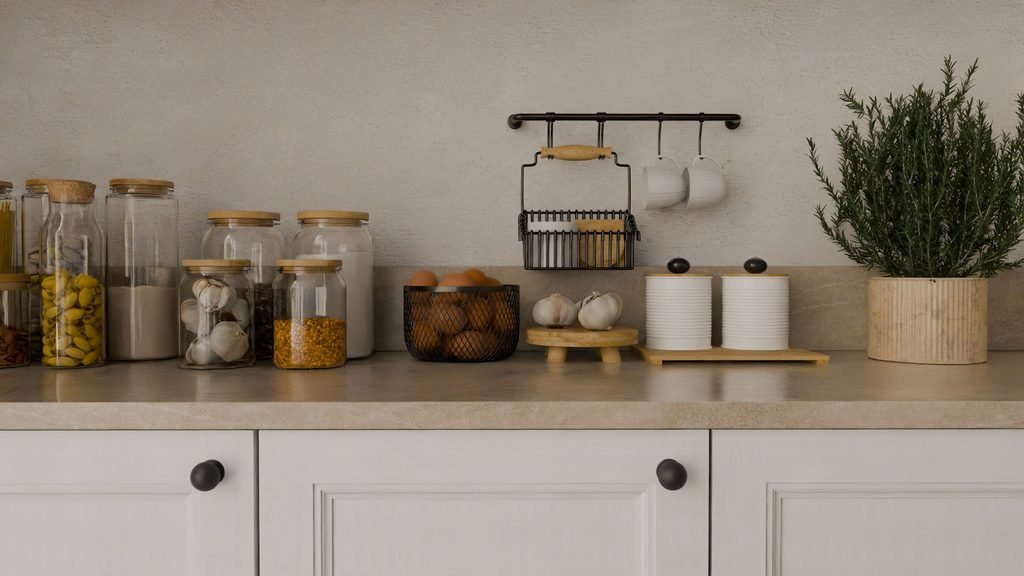
13. Decant only what you finish quickly
Transferring dry goods into matching airtight containers saves space and looks tidy, but decanting everything is a mistake. Choose the fast movers, such as flour, sugar, rice, and pasta, and leave snacks and cereal in their original packaging. Keep cooking instructions and best-by dates with the container, for example by taping the label to the lid or the back.
Cost: About 20–80 for a set. Renter-friendly: Yes.
14. Label contents and dates
Two flours that look identical but behave differently are a baking disaster waiting to happen. Kitchen Organization Ideas Label every decanted container with its contents and the date you filled it. Masking tape and a marker work perfectly well, and a label maker is a nice upgrade rather than a requirement.
Cost: About $5 for tape and a marker. Renter-friendly: Yes.
15. Group by category in bins
Instead of arranging individual items, assign each shelf a category: baking, breakfast, snacks, canned goods. Place small items in bins with handles so you can pull a whole category forward at once. Kitchen Organization Ideas Open-front bins are easier than lidded ones, because you do not have to unstack anything to reach what you need.
Cost: About 5–25 per bin. Renter-friendly: Yes.
16. Add an over-the-door pantry rack
A slim rack on the inside of the pantry door holds spices, small cans, or snack bags, using space that otherwise does nothing. Check the door clearance first. The rack, plus its contents, must not hit the shelves when the door closes. Respect the stated weight limit on the packaging.
Cost: About 20–60. Renter-friendly: Yes, if it hooks over the door.
17. Use tiered risers for cans and spices
Deep shelves hide whatever sits in the back. A stepped riser lifts the rear row so every label is visible at once. For spices, avoid placing them directly above the stove, since heat and light can dull flavor over time. A cooler, darker drawer or shelf is better.
Cost: About 10–30. Renter-friendly: Yes.
18. Create an eat-first basket
This is the first-in, first-out idea in its simplest form. Keep a small basket near the front of the shelf for items that are close to their date or already open. When you plan meals, start there. New groceries go behind older ones. It costs nothing and cuts food waste.
Cost: Free to $10. Renter-friendly: Yes.
Fridge and Freezer Organization Ideas
19. Zone the fridge by food safety
Store ready-to-eat foods and dairy on upper shelves, and raw meat, poultry, and fish on the lowest shelf in a sealed container so juices cannot drip onto other food. Keep produce in the crisper drawers. Kitchen Organization Ideas Condiments are fine in the door, but milk and eggs generally keep better inside the main compartment, because the door is the warmest spot. Aim to keep the fridge at or below 40°F (4°C) and check it with an inexpensive appliance thermometer.
Cost: Free; thermometer about 5–15. Renter-friendly: Yes.
20. Use a few clear bins, not many
Bins help when they match what you buy repeatedly: yogurt, cheese, snack packs, or drinks. Too many bins reduce flexibility, because your groceries change every week. Start with two or three and add more only where you notice a recurring mess. Clear bins with handles let you pull out a full category.
Cost: About 10–30. Renter-friendly: Yes.
21. Stand freezer bags upright
Freeze soups, sauces, and ground meat flat in zip bags, then stand them upright like files in a bin. You get more usable space and can see every bag. Write the item and the date on each bag, and keep the freezer at 0°F (-18°C). Group by category, such as proteins, vegetables, and prepared meals.
Cost: About 10–25 for bins. Renter-friendly: Yes.
Under-Sink, Counter, and Vertical Space Ideas
22. Organize under the sink with a two-tier organizer
The space under a sink is awkward because of the pipes. Use a two-tier organizer with a cutout, or a caddy for daily cleaning supplies, and put a waterproof tray at the bottom to catch leaks. Store cleaning products out of reach of children, and keep bleach separate from ammonia-based cleaners. Never mix cleaning products.
Cost: About 15–45. Renter-friendly: Yes.
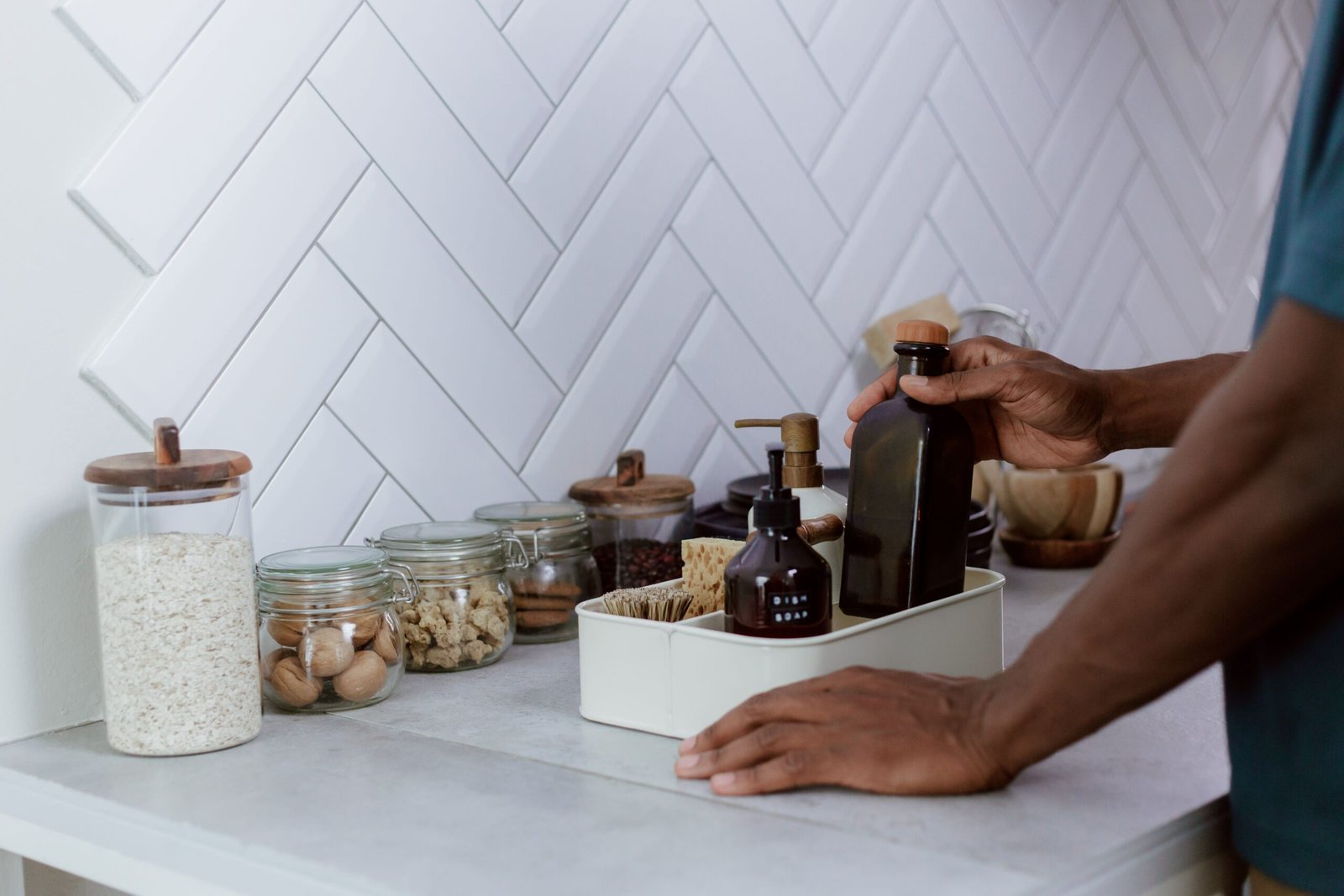
23. Corral daily items on a tray
Oil, salt, pepper, and your favorite cooking spoon can live on one small tray beside the stove. Kitchen Organization Ideas The tray defines the limit, so when it is full, nothing else joins it. It also lifts everything in one move when you wipe the counter.
Cost: About 10–30. Renter-friendly: Yes.
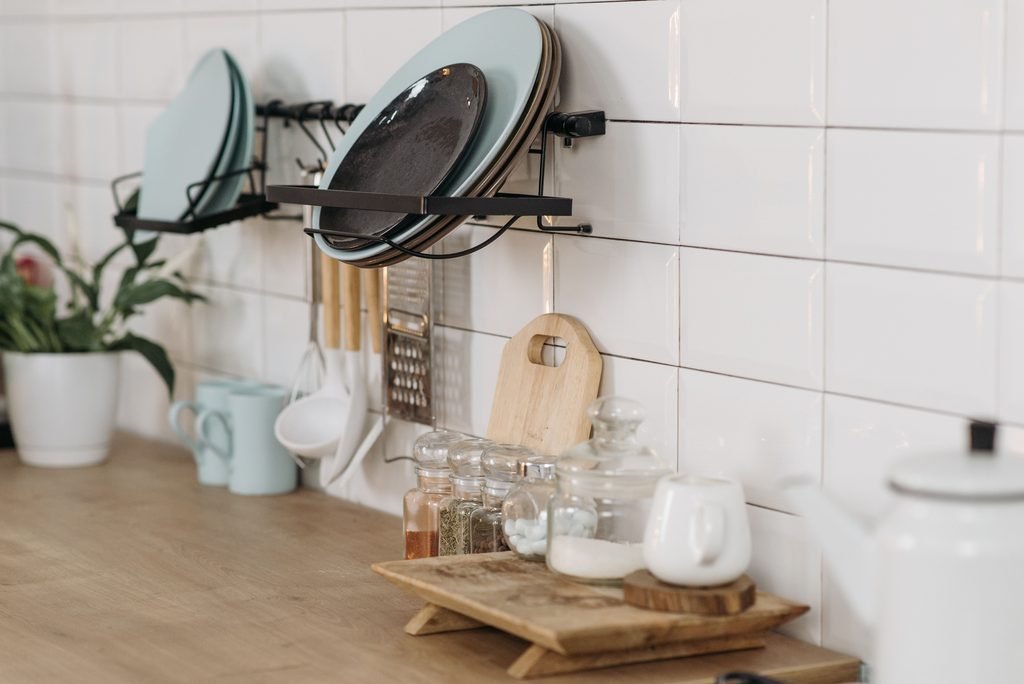
24. Mount a wall rail with hooks
A rail turns blank wall space into storage for utensils, mugs, or pots. For anything heavier than a few light tools, anchor the rail into wall studs or use proper wall anchors, and check the rail’s stated weight rating. Hang only what you use daily. A rail that holds everything quickly becomes visual clutter.
Cost: About 15–60. Renter-friendly: Only if your lease allows screws; adhesive options suit light items only.
25. Add a rolling cart
A slim cart adds a work surface and shelves where cabinets cannot go. Look for a width of roughly 12–16 inches for tight spaces, and choose wheels that lock. Before you buy, check that you can still walk and open appliance doors comfortably. Design guidelines commonly cite a work aisle of about 42 inches for one cook.
Cost: About 40–150. Renter-friendly: Yes.
Budget Guide at a Glance
| Budget | What it covers | Examples from this list |
| Free | Habits and layout changes | Ideas 1, 12, 18, 19 |
| Under $50 | Most organizers | Ideas 2, 4, 8, 10, 14, 17, 23 |
| 50–150 | Larger pieces | Idea 25, plus a full pantry set |
| Over $150 | Installed or custom storage | Fixed pull-out systems from Idea 3 |
Common Kitchen Organizing Mistakes to Avoid
- Buying before measuring. Wrong-size organizers are the most common waste of money. Kitchen Organization Ideas Measure shelves, drawers, and door openings first.
- Organizing clutter. If you have three of everything, storage will not fix it. Declutter first.
- Overloading hooks and rails. Every hook, rod, and rail has a weight rating. Follow it, and hang heavy items on anchored mounts only.
- Decanting everything. It takes time and loses the original instructions and dates. Decant selectively.
- Building a system you cannot maintain. If putting something back takes more than a few seconds, you will stop doing it.
A Simple Weekend Plan
Saturday morning: Declutter and clean one zone at a time, starting with the pantry. Saturday afternoon: Measure, then order only the organizers you need. Sunday: Install the organizers, label the containers, and reset the fridge. Keep the receipts for a couple of weeks in case a measurement was off.
Frequently Asked Questions
What is the first step in organizing a kitchen?
Declutter. Remove duplicates, expired food, and tools you do not use. Organizing before decluttering only rearranges the mess.
How do I organize a small kitchen with little storage?
Use vertical space first: shelf risers, a wall rail, and an over-the-door rack. Then add a slim rolling cart if floor space allows. Keep only the items you use at least a few times a month in the main cabinets.
What are the best kitchen organization ideas for renters?
Freestanding and non-permanent options: shelf risers, lazy Susans, drawer dividers, over-the-door racks, tiered shelves, and rolling carts. Avoid anything that requires screws unless your lease allows it.
How should I arrange food in the fridge?
Put ready-to-eat foods and dairy on upper shelves, raw meat on the lowest shelf in a sealed container, and produce in the crisper. Keep the temperature at or below 40°F (4°C).
How much does it cost to organize a kitchen?
A free reset costs only time. A basic set of organizers often falls in the 50–150 range, and installed pull-out systems cost more. Prices vary by region and brand.
Final Thoughts
Good kitchen organization ideas are not about buying more containers. They are about giving every item a logical home, measuring before you buy, and choosing systems you can maintain in a few seconds a day. Start with one cabinet or drawer, finish it completely, and let the result guide your next step. Small, finished projects beat big, abandoned ones every time.