
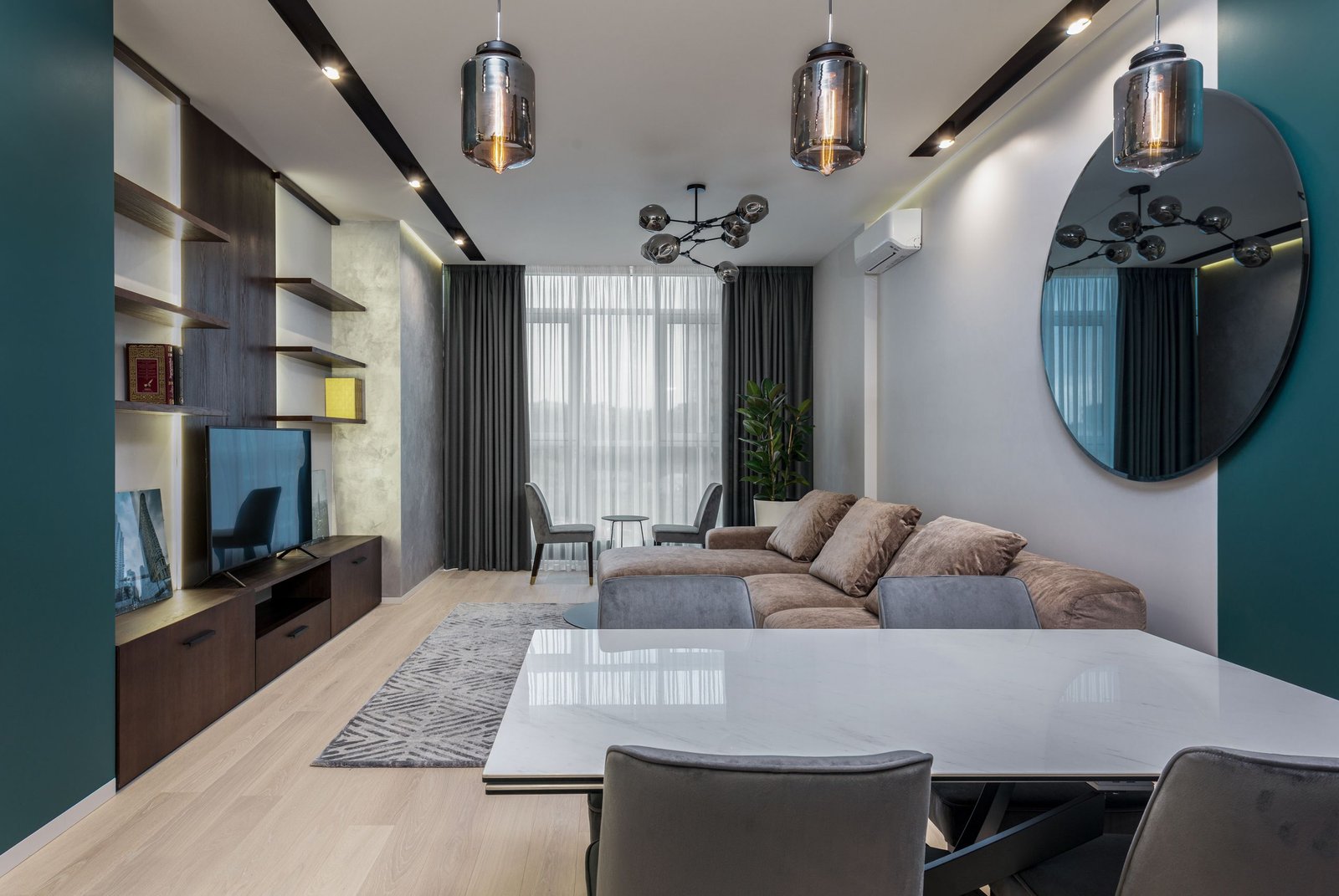
A small living room does not have to feel cramped just because it includes a television. In fact, the right TV placement can help define the room, organize the furniture, and create a comfortable place to relax.
The challenge is usually everything around the screen. An oversized entertainment center, deep sofa, tangled cables, or too many decorative pieces can quickly consume the limited space. The solution is to think about the TV as part of the entire room rather than treating it as a separate feature.
From wall-mounted screens and floating consoles to cozy corners and built-in shelving, there are plenty of ways to make small living rooms with TVs feel balanced and inviting. The best approach depends on the room’s shape, furniture, windows, viewing distance, and how you use the space.
Here are 21 practical ideas to help you create a TV setup that looks intentional without sacrificing valuable floor space.
21 Small Living Rooms With TVs That Look Stylish
1. Blend the TV Into a Dark Wall
A dark wall can make a television feel less visually dominant. Black, charcoal, deep blue, and other darker shades create a similar visual background to the screen, helping it blend into the surrounding surface.
This approach works especially well when the TV is mounted directly on the wall. A simple console underneath can provide storage without adding another large visual element.
You do not need to paint the entire living room dark. A single TV wall can be enough to establish contrast while keeping the rest of the room lighter.
2. Mount the TV Above a Slim Console
Wall-mounting is one of the most practical solutions for a compact living room because it removes the need for a traditional TV stand.
A slim console underneath can still provide storage for remotes, streaming devices, books, or other items. Choose a console that is shallow enough to preserve the walking area in front of it.
The combination also creates a clear vertical arrangement. The screen occupies the wall while the console handles the storage below.
3. Create a Cozy TV Corner
Not every TV needs to sit in the middle of the largest wall.
A corner can sometimes be a better choice, particularly when the main walls are interrupted by windows, doors, fireplaces, or other architectural features. Placing the TV in an unused corner can free the main wall for furniture or artwork.
Before choosing this arrangement, consider the viewing angle. Everyone using the sofa should be able to see the screen comfortably without constantly turning their head.
4. Use a Floating TV Console
A floating console is attached to the wall instead of resting directly on the floor. This small change can make a compact room appear more open because some of the floor remains visible beneath the furniture.
It also gives the TV wall a clean, contemporary appearance. Closed drawers or cabinets can hide everyday items and keep the area visually quiet.
For renters, however, installation requirements matter. A floating unit needs secure attachment to an appropriate wall structure, so it may not be practical in every home.
5. Surround the TV With Built-In Shelving
Instead of allowing the television to stand alone, surround it with shelving. This turns the screen into one part of a larger composition.
Shelves can hold books, plants, artwork, baskets, or a limited number of decorative objects. Closed cabinets can handle less attractive equipment.
The important part is restraint. Filling every shelf can make a small room look busier than it actually is. Leave some open space so the television remains visually clear.
6. Try a Frame-Style TV
A frame-style television can be useful for people who dislike the appearance of a large black screen when the TV is turned off.
When the television is not being used, an art-display mode can help it function visually as part of the room. Samsung’s The Frame is one example of this approach.
This does not necessarily save physical space, but it can reduce the visual contrast between the screen and the rest of the decor. In a carefully styled small living room, that distinction can make a noticeable difference.
7. Choose a Low-Profile TV Stand
A low TV stand can keep the entertainment area visually compact without requiring wall installation.
Look for a unit with enough width and storage for your needs but avoid unnecessary height and depth. A low console can make the wall feel less crowded while still providing a stable place for the television.
This option can also work well for renters who cannot drill into their walls or simply prefer furniture that can be moved later.
8. Create a Minimal White TV Wall
Light colors can help a small living room maintain an airy appearance. A white or soft-neutral TV wall combined with simple furniture creates a clean background for the screen.
The trick is not to fill the space with accessories. Use a few carefully selected elements and allow some empty wall area to remain visible.
Light wood, neutral upholstery, and simple shapes can complement this arrangement without competing with the television.
9. Frame the TV With Wood Paneling
Wood paneling can give a television wall warmth and architectural character. It also helps make the screen feel like an intentional part of the room rather than a piece of technology placed on an otherwise empty wall.
You can use natural wood tones for a warmer look or a painted finish for a more contemporary effect.
In a small room, avoid making the paneling excessively complicated. A simple vertical or horizontal treatment is often enough to establish a focal point.
10. Balance the TV With Artwork
A television does not have to be the only visual feature in the living room.
Artwork placed around the room can balance the strong rectangular shape of the screen. You can use framed prints, photographs, small sculptures, or other decorative elements that complement the room’s overall style.
The goal is not to cover every inch around the TV. Too much artwork can create visual competition. Instead, distribute decorative elements thoughtfully so the room feels balanced.
11. Use Vertical Storage
When floor space is limited, look upward.
Tall shelving can provide useful storage without requiring a wide entertainment center. Vertical storage is particularly useful in narrow living rooms where horizontal furniture can quickly restrict movement.
Use a mixture of open and closed storage when possible. Everyday clutter can disappear behind cabinet doors, while books and decorative pieces can occupy selected open shelves.
This approach makes better use of wall height while keeping the floor relatively clear.
12. Hide Electronics Below the Screen
Streaming devices, game consoles, remotes, controllers, and cables can quickly make a small TV area look messy.
Closed storage below the screen can solve much of this problem. A cabinet or media console can keep equipment organized while reducing the number of visible objects.
Cable management matters too. Even an attractive TV wall can look unfinished when wires hang visibly beneath the screen.
A simple setup usually looks better than a crowded one.
13. Add Lighting Around the TV
Lighting can help prevent the television wall from becoming the only strong visual feature in the room.
Wall sconces, subtle accent lights, or integrated lighting can add depth around the screen. The light should support the room rather than create glare on the television.
Placement matters here. Avoid positioning bright lights directly opposite the screen if they create reflections.
A few carefully positioned sources are generally more effective than filling the entire TV wall with decorative lighting.
14. Try a Scandinavian-Inspired Setup
Scandinavian-inspired interiors can work particularly well in compact rooms because they tend to favor simplicity, natural materials, light colors, and functional furniture.
A small TV area might combine a pale wood console, neutral sofa, simple textiles, and a limited number of accessories.
The style is not about making the room completely empty. It is about giving each piece a clear purpose.
That makes it easier to keep a television from overwhelming the room.
15. Use Graphic Wallpaper Behind the TV
Wallpaper can turn an otherwise plain TV wall into a deliberate design feature.
A subtle geometric pattern, textured design, or restrained botanical print can create a background that gives the television more context within the room.
When using patterned wallpaper in a small space, consider the rest of the decor carefully. If the TV wall already has a strong pattern, simpler furniture and accessories can prevent the room from feeling visually crowded.
16. Create a Compact Sectional Layout
A sectional can work in a small living room, but scale is critical.
Choose a sectional that fits the actual dimensions of the room rather than selecting the largest sofa that can physically fit through the door. Excessive depth can make the room difficult to navigate.
Position the seating so it faces the television without blocking important walkways.
A compact sectional can actually simplify the layout by combining several seating positions into one piece of furniture.
17. Use a Narrow Media Console
Console depth is easy to overlook when planning a small living room.
A media console that projects too far into the room can interfere with walking paths and make the entire TV wall feel bulky. A narrower unit can provide the storage you need while taking up less usable floor area.
Measure the available space before buying furniture. Pay attention not only to width but also to depth, door clearance, and the distance between the console and nearby seating.
Every inch matters more in a compact room.
18. Build a Cozy Apartment TV Nook
Apartment living often requires one area to serve several purposes.
A compact TV nook can combine a sofa or loveseat, a small media unit, storage, and lighting within one defined zone. This creates a sense of organization without requiring a separate entertainment room.
Use furniture that matches the proportions of the space. A small console, compact seating, and wall-mounted television can create a functional setup without overwhelming the room.
This is particularly useful in studio apartments where the living room may also share space with dining, work, or sleeping areas.
19. Make the TV Part of a Gallery Wall
A gallery wall can help integrate the TV into a broader decorative arrangement.
Rather than placing artwork randomly around the screen, think about the overall composition. Similar frame finishes, consistent spacing, and a controlled color palette can help create cohesion.
Leave enough breathing room around the television so it remains easy to watch.
The gallery wall should support the TV area, not compete with it.
20. Try a Black-and-White TV Setup
Black and white can create a simple, sophisticated TV arrangement.
The television naturally introduces a large black rectangle into the room, so repeating small amounts of black elsewhere can make the screen feel intentional. A black lamp, picture frame, table, or decorative object can create visual connections.
White walls and light upholstery can keep the room bright, while black accents provide definition.
The result does not need to be stark. Soft textures and natural materials can make a monochromatic room feel comfortable.
21. Make the TV Wall the Main Focal Point
There is no rule saying that a TV has to be hidden.
In some small living rooms, making the television wall the main focal point can actually create a cleaner design. The key is to build the entire arrangement around it.
A well-proportioned console, attractive wall treatment, balanced lighting, and organized storage can make the TV look intentional.
Instead of trying to disguise the screen, treat it as one of the room’s primary functions and design around it.
How to Make a TV Look Good in a Small Living Room
Good small living room TV ideas begin with the room itself. Before buying furniture or choosing a wall treatment, consider how people actually move through the space.
Choose the Right TV Size
A larger television is not automatically better for a small living room.
The screen should be appropriate for the viewing distance and the room’s proportions. Sony’s guidance explains that viewing distance varies according to both screen size and resolution, so there is no single TV size that works for every compact room.
Measure the distance between the likely seating position and the TV before making a decision. Also consider the physical width and height of the television rather than relying only on its advertised diagonal screen measurement.
Mount the TV or Use a Slim Stand
Wall mounting can be useful when floor space is extremely limited. It removes the footprint of a traditional stand and creates a cleaner TV wall.
A slim stand, however, has advantages of its own. It provides storage, can be moved more easily, and may be preferable for renters or people who do not want to modify their walls.
Neither option is universally better.
The right choice depends on whether your priority is maximum floor space, storage, flexibility, or installation convenience.
Keep the TV Area Uncluttered
A small room has less visual capacity, so clutter becomes noticeable quickly.
Avoid placing too many decorative objects around the television. Choose a few items that contribute to the room’s overall design and keep everyday electronics organized.
Negative space is useful. An empty section of wall or an uncluttered console can make the entire arrangement feel calmer.
Use Storage Strategically
Storage should solve a problem rather than simply fill a wall.
Closed cabinets are useful for hiding controllers, cables, chargers, gaming accessories, and other items that do not need to remain visible. Open shelves are better suited to books, plants, artwork, and carefully selected decorative pieces.
A combination of both can provide function without making the TV wall look like a storage unit.
Pay Attention to Furniture Scale
Furniture that is technically small enough to fit can still be too bulky for the room.
A deep sofa may reduce the available walking area. A wide console may crowd the opposite wall. Oversized chairs can make it difficult to move between the seating area and the rest of the home.
Look at the entire arrangement rather than judging each piece separately.
Protect Walking Paths
A beautiful TV wall is not successful if everyone has to squeeze past the furniture.
Keep the main paths through the living room clear. Consider doors, windows, hallways, entrances, and access to other parts of the home before finalizing the arrangement.
Function should come before decoration.
Where Should You Put a TV in a Small Living Room?
There is no universal answer to the best TV placement. The right position depends on the room’s architecture, seating arrangement, windows, doors, viewing angle, and traffic flow.
Main Wall Placement
A central wall is often the most straightforward option because the sofa can face the screen directly.
This arrangement works particularly well when the wall is uninterrupted and large enough to accommodate the TV and a slim console without crowding nearby furniture.
Corner TV Placement
A corner can be useful when the main walls are occupied by windows or doors.
It can also make use of an otherwise awkward section of the room. However, check the viewing angle carefully before committing to this layout.
TV Above a Console
A TV mounted above a console combines wall space with practical storage.
The console should be proportionate to the TV and should not be so deep that it interferes with movement through the room.
TV Within Built-In Shelving
Built-in shelving can create a complete media wall with storage surrounding the screen.
This is a more permanent solution, but it can be highly effective when planned around the room’s exact dimensions.
Floating TV Unit
A floating unit can keep the lower part of the wall visually open while still providing storage.
It works particularly well with modern and minimalist interiors.
Open-Plan Living Room Placement
In an open-plan home, the TV may need to serve as a visual boundary between the living area and another zone.
Consider how the screen interacts with the dining area, kitchen, windows, and major walking paths before deciding where it belongs.
Avoiding Window Glare
Windows can create reflections that make a television difficult to watch.
Whenever possible, consider the direction of natural light before selecting the TV wall. Curtains or blinds may help, but thoughtful placement is usually the better starting point.
Choosing a Comfortable Viewing Height
Avoid automatically placing the TV near the ceiling.
The screen should be positioned in relation to the normal seating position. A TV that is unnecessarily high can make comfortable viewing difficult, even if the wall itself has plenty of unused space above.
Small Living Room TV Mistakes to Avoid
Choosing an Oversized Entertainment Center
Large entertainment centers consume both physical and visual space.
A compact room usually benefits from furniture that performs the necessary function without adding unnecessary bulk.
Using Furniture That Is Too Deep
Depth can be more problematic than width.
A deep sofa or console can significantly reduce walking space, even when the furniture technically fits within the room.
Ignoring Cable Clutter
Visible wires can undermine an otherwise polished setup.
Use appropriate cable-management methods to keep wires organized and out of sight where practical.
Mounting the TV Too High
A television does not need to be positioned near the ceiling simply because there is empty wall space above it.
Consider the viewer’s normal eye level and seating position first.
Blocking Natural Light
Do not sacrifice a room’s main source of natural light simply to create a television wall.
Windows influence both the atmosphere of the room and the amount of glare reaching the screen.
Overdecorating the TV Wall
Too many shelves, frames, plants, and accessories can compete with the screen.
A carefully edited arrangement often looks better than a wall packed with decoration.
Ignoring the Sofa-to-TV Relationship
The TV and sofa should be planned together.
A television may look perfectly positioned on its own but still create an uncomfortable room if the seating is too close, too far away, or poorly aligned with the screen.
Quick Comparison
| TV Setup | Best For | Key Benefit | Limitation |
| Wall-mounted TV | Very small rooms | Saves floor space | Provides little built-in storage |
| Slim TV console | Renters and flexible layouts | Easy to reposition | Uses some floor space |
| Floating console | Modern compact rooms | Keeps the floor visually open | Requires secure wall installation |
| Built-in TV wall | Long-term homeowners | Combines storage and entertainment | More permanent and costly |
| Corner TV setup | Awkward room layouts | Uses an underused area | May limit viewing angles |
Frequently Asked Questions
How do you fit a TV in a very small living room?
Wall-mounting the TV, choosing a slim or floating console, and using appropriately scaled seating can help preserve valuable floor space. Keep electronics organized and avoid oversized entertainment furniture.
Where should a TV go in a small living room?
The best location depends on the room’s walls, windows, doors, seating arrangement, viewing angle, and traffic flow. A central wall, corner, or integrated media wall can all work.
Should a TV be mounted in a small living room?
It can be useful because mounting removes the floor footprint of a traditional TV stand. However, a slim console may be more practical when storage or flexibility is important.
What size TV is best for a small living room?
There is no universal TV size for every small room. Consider viewing distance, seating position, wall dimensions, screen dimensions, and the room’s overall proportions before choosing a television.
How can I make my TV less noticeable?
A dark wall, built-in shelving, wood paneling, surrounding artwork, a frame-style TV, or a simple media wall can help the screen feel more integrated with the room.
How do you decorate around a TV in a small room?
Keep the arrangement balanced and avoid excessive decoration. Shelves, artwork, plants, lighting, and closed storage can add interest while leaving enough visual space around the screen.
Can a small living room have a sectional and TV?
Yes. The key is choosing a sectional that matches the room’s dimensions and preserves comfortable walking paths. A compact sectional can provide several seats without requiring multiple chairs.
How do I hide TV wires in a small living room?
Cable-management channels, organized cord covers, and suitable furniture can help keep wires concealed. In-wall routing may be possible in some situations, but it should be handled safely and according to applicable installation requirements.
Is a TV stand better than mounting a TV?
Neither option is automatically better. Mounting generally saves floor space, while a TV stand provides storage and can be moved more easily. Choose based on your room, furniture, wall, and storage needs.
How do I make a small living room look bigger with a TV?
Use appropriately scaled furniture, preserve visible floor space, reduce clutter, choose a suitable TV size, and keep walking paths open. A floating console or wall-mounted TV can also reduce the visual weight of the entertainment area.
Conclusion
A small living room does not have to choose between a comfortable layout and a television. With the right arrangement, the screen can become a natural part of the room instead of an object that dominates it.
Start with the practical details. Measure the room, consider viewing distance, look at the available walls, and think about how people move through the space. Then choose furniture that fits those conditions rather than trying to force a particular layout into the room.
From a floating console to a cozy corner setup, there are many ways to create attractive small living rooms with TVs. The best design is ultimately the one that fits your space, supports comfortable viewing, provides the storage you need, and leaves enough room to live comfortably.
