
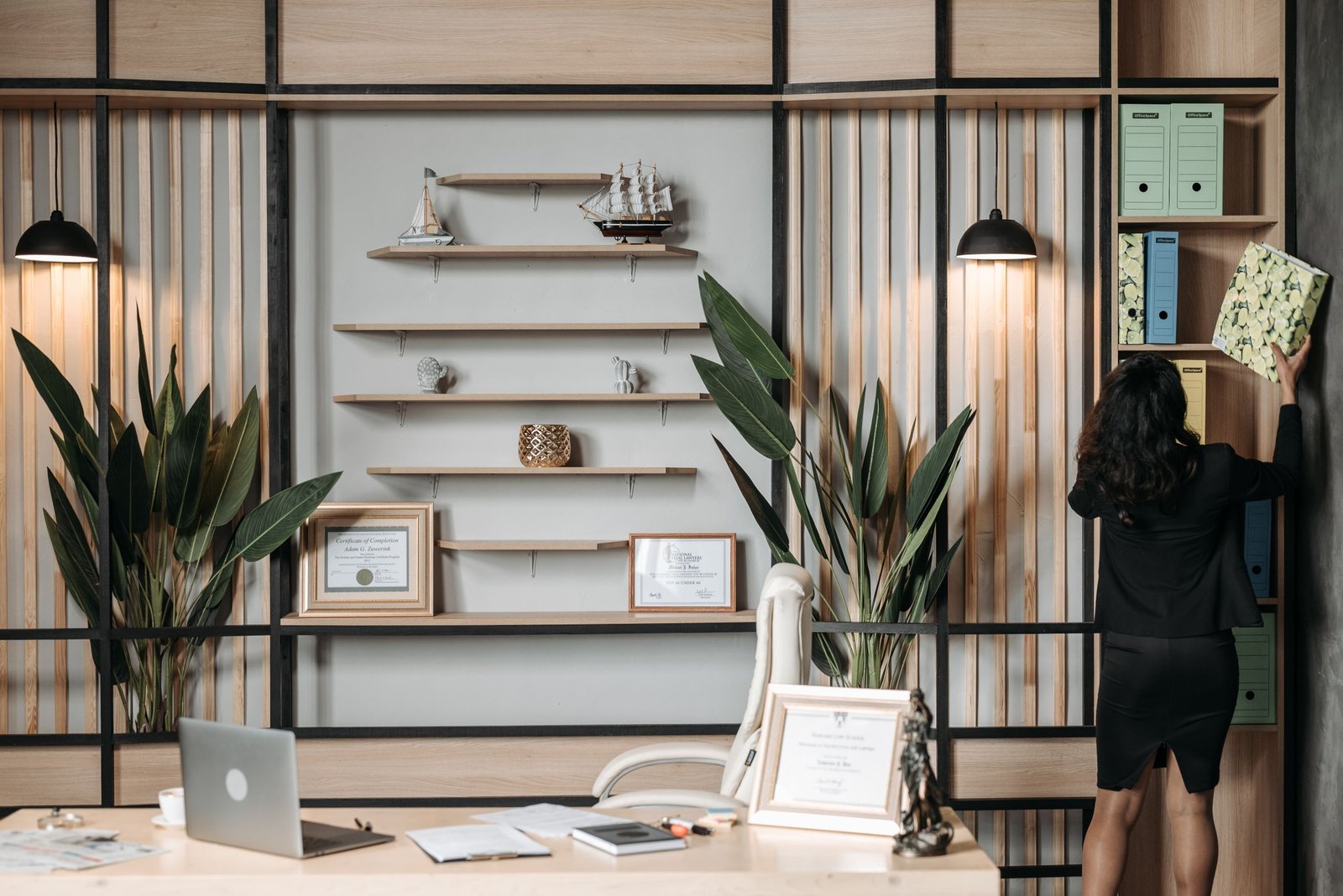
Shelves can seem easy to decorate until you actually have to arrange them. A few books, a vase, some photographs, and a plant may sound like enough, yet the finished display can still look crowded, flat, or unfinished.
The difference usually comes down to arrangement rather than the objects themselves. Good shelf styling uses height, scale, texture, color, layering, and empty space to create a display that feels intentional.
These shelf decor ideas cover different rooms, shelf types, decorating styles, and budgets. Some focus on purely decorative displays, while others combine storage with visual appeal. You don’t need to buy everything shown in a typical design photo, either. Many attractive shelves can be created by rearranging pieces you already have.
How to Style Shelves Like a Pro
Before choosing individual decorations, it helps to understand a few basic styling principles. These make it easier to create a cohesive display instead of simply filling available space.
Start With a Focal Point
Every shelf arrangement benefits from something that immediately catches the eye. This could be a large vase, framed artwork, sculpture, mirror, plant, or meaningful object.
A focal point doesn’t have to sit directly in the center. Placing a larger piece slightly off-center can create a more relaxed arrangement, especially when smaller objects balance its visual weight elsewhere.
Start with the strongest piece you want to display.
Then build around it.
Mix Heights and Shapes
Objects that are all the same height tend to create a flat-looking display. Instead, combine tall, medium, and short pieces.
For example, a tall vase can sit beside a medium-sized frame, while a small bowl or decorative object fills the lower visual space. Different shapes also prevent the arrangement from looking repetitive.
Think vertically as well as horizontally.
Layer Objects for Depth
Layering makes shelves look more collected and gives individual pieces more visual importance. A framed picture can sit behind a small plant, while a few books can create a platform for a shorter object.
Not everything needs to sit at the very front edge of the shelf.
Leaving some objects farther back creates depth and keeps the display from looking like a row of unrelated items.
Leave Some Negative Space
Empty space is part of the design. A shelf does not need to be filled from one end to the other.
Negative space gives decorative pieces room to stand out and prevents the arrangement from becoming visually exhausting. If everything feels crowded, removing one or two objects may improve the display more than adding another decoration.
Repeat Colors, Materials, or Shapes
Repetition creates a visual connection between objects that don’t necessarily match.
For example, small touches of black can appear in a frame, vase, and sculpture. Natural wood might appear in books, a tray, and a decorative object. These repeated elements help the arrangement feel connected without requiring every piece to come from the same collection.
Mix Decorative and Personal Pieces
A shelf can look beautiful without feeling impersonal. Combine decorative objects with books, photographs, souvenirs, inherited pieces, artwork, or collectibles.
Personal objects often give a display more character because they tell something about the people who live in the home.
42 Shelf Decor Ideas
1. Layer Books With Decorative Objects
Books are among the easiest pieces to incorporate into shelf styling. Stand some vertically and stack others horizontally to create height variation.
A horizontal stack can also act as a small platform for a vase, sculpture, candleholder, or other lightweight object. This makes books functional parts of the composition instead of simply filling shelf space.
2. Add a Statement Vase
A large vase can become the anchor of a shelf arrangement. Choose a shape or finish that complements the surrounding room rather than trying to make the vase match everything exactly.
Place it beside shorter pieces so its height remains noticeable. An oversized vase can work particularly well on larger built-in shelves where small decorations might otherwise disappear.
3. Bring in Greenery
Plants add color, softness, and natural texture to shelving. A trailing plant can soften the edge of a floating shelf, while an upright plant can introduce height.
If natural plants aren’t practical, faux greenery, branches, flowers, or dried stems can create a similar visual effect.
4. Create a Gallery Shelf
Instead of hanging every picture separately, lean several framed artworks or photographs against the back of a shelf.
Use different frame sizes while maintaining one or two connecting elements, such as color or material. Smaller objects can be placed in front of the frames to create layers.
5. Try the Rule of Three
Three objects can provide an easy starting point for creating a balanced group.
Try combining pieces with different heights and shapes, such as a small vase, a medium frame, and a taller decorative object. The objects don’t have to match. Their relationship is what matters.
6. Mix Vertical and Horizontal Books
A long row of upright books can sometimes look too uniform. Break it up with horizontal stacks.
You can alternate between vertical and horizontal arrangements across several shelves, then use a decorative object on top of one or two stacks. This creates rhythm while keeping books easily accessible.
7. Add a Small Sculpture
A sculpture introduces shape and personality that rectangular books and frames often lack.
Look for a piece that has enough visual weight to be noticed without overwhelming the other decorations. Sculptural objects work especially well when the rest of the shelf contains simpler shapes.
8. Use Decorative Bowls
Bowls and shallow vessels are useful low-profile accents. They can fill an empty area without adding excessive height.
A decorative bowl can also hold small practical items, although the contents should be limited if you want the display to remain tidy.
9. Display Meaningful Keepsakes
Shelves don’t have to be filled entirely with items chosen for their appearance. Travel souvenirs, inherited objects, collectibles, and sentimental pieces can make a room feel more personal.
Group meaningful objects with simpler decor so they receive attention without making the shelf feel like a collection of unrelated items.
10. Style With Baskets
Baskets combine storage and decoration. They are especially useful on open shelving where smaller items need to be hidden.
Woven baskets can introduce texture while keeping paperwork, accessories, toys, or other loose items organized.
11. Add a Decorative Mirror
A small mirror can add another shape while reflecting light around the room.
Lean it against the back of a shelf rather than mounting it if the shelf design allows. Pair it with smaller objects in front to create depth.
12. Create a Neutral Shelf Display
A neutral shelf can use shades such as white, cream, beige, taupe, soft gray, and natural wood.
The key is to create interest through texture and shape rather than relying heavily on color. Ceramic, woven, wooden, and glass pieces can keep a restrained palette from looking dull.
13. Use One Bold Accent Color
A neutral shelf doesn’t need to remain completely neutral. One stronger color can give the arrangement more energy.
For example, a predominantly cream and wood display could include one deep blue, green, terracotta, or black accent. Repeating that color in one other small object can make it feel intentional.
14. Mix Different Textures
Texture is especially useful when a shelf has a limited color palette.
Combine smooth ceramic with rough wood, woven baskets, glass, metal, or textured fabrics. The differences become noticeable even when the colors remain similar.
15. Try an Asymmetrical Arrangement
Symmetry can create order, but shelves don’t always need matching objects on both sides.
Place a larger object on one side and balance it with two or three smaller pieces on the other. The goal is to balance visual weight rather than create identical halves.
16. Style a Floating Shelf Simply
Floating shelves often look better with fewer, appropriately scaled pieces.
Because these shelves tend to have limited depth, oversized collections of small objects can quickly become crowded. Try one taller item, a small stack of books, and one or two lower accents.
17. Decorate Built-In Shelves
Built-in shelving provides more space, but that doesn’t mean every section needs to be completely full.
Treat each compartment as a small composition while keeping a consistent color story across the entire unit. Repeat a few materials or colors to connect separate sections.
18. Create a Cozy Reading Shelf
Books naturally create the foundation for a reading-themed display.
Add a small lamp, framed artwork, plant, or decorative object. Keep the arrangement comfortable and practical rather than turning every shelf into a purely decorative display.
19. Use Vintage Pieces
Vintage objects can add character and make a shelf feel collected over time.
Mix older pieces with contemporary books, artwork, ceramics, or modern accessories. The contrast often feels more natural than using only items from one period.
20. Try a Minimalist Shelf
Minimalist shelf styling relies on careful editing.
Choose a few objects with strong shapes or useful functions and leave plenty of open space around them. This approach works particularly well in modern rooms where visual simplicity is part of the overall design.
21. Add Candles or Candleholders
Decorative candleholders can introduce height, shape, and warmth.
Even when candles are not being used, sculptural holders can function as decorative objects. Group them with books or ceramics instead of placing several identical pieces together.
22. Display Ceramics
Ceramic pieces offer a wide range of shapes, colors, and finishes.
Try grouping pottery in different sizes rather than lining up several identical pieces. A large ceramic vessel can anchor the arrangement while smaller pieces fill nearby spaces.
23. Create a Tonal Display
A tonal display uses several shades of the same general color family.
For example, different shades of beige can be combined with cream, tan, and natural wood. Since the colors are closely related, differences in texture and shape become more important.
24. Add Framed Photos
Personal photographs prevent shelves from feeling too staged.
Use a mixture of photo sizes and frame styles, but keep some visual connection between them. A few photographs can be layered behind books or other objects for a more relaxed arrangement.
25. Style With Natural Wood
Wooden objects can add warmth to shelves dominated by white, gray, black, or other cool finishes.
Use wooden bowls, frames, boxes, sculptures, or small architectural pieces. Natural variations in grain can also introduce subtle texture.
26. Use Decorative Boxes
Decorative boxes are useful when you want hidden storage without sacrificing appearance.
They can hold small items while contributing color, pattern, or texture to the shelf. Place them near open decorative objects to balance practical storage with display pieces.
27. Create a Coastal-Inspired Shelf
A coastal shelf doesn’t need to rely on obvious nautical decorations.
Use light colors, natural wood, woven textures, glass, soft blue or green accents, and organic shapes. Keeping the palette subtle can create a coastal feeling without making the display look themed.
28. Try a Modern Black-and-White Display
Black and white create strong visual contrast.
Use black frames, books, ceramics, or sculptures against lighter objects. Because the contrast is already strong, keep the overall number of pieces controlled so the shelf doesn’t become visually busy.
29. Add Small Decorative Trays
A tray can turn several small objects into one organized group.
Place a candle, small bowl, and another decorative item on the tray rather than scattering all three across the shelf. This creates a clearer visual zone.
30. Style a Kitchen Shelf
Kitchen shelves need to balance appearance and function.
Display attractive everyday pieces such as plates, mugs, bowls, jars, cookbooks, or serving pieces. Add a small plant or decorative object where space allows, but keep frequently used items accessible.
31. Decorate a Bedroom Shelf
Bedroom shelves generally benefit from softer and more personal arrangements.
Try combining books, framed photographs, greenery, ceramics, and a few meaningful objects. Avoid filling the shelf with too many visually active pieces, particularly in a room designed for rest.
32. Style a Home Office Shelf
Home office shelves can combine organization with personality.
Use books, storage boxes, files, artwork, plants, and a few decorative accents. Keep frequently needed supplies accessible while using closed boxes to hide items that would otherwise make the space look untidy.
33. Create Bathroom Shelf Decor
Bathroom shelving can be both useful and decorative.
Folded towels, small plants, containers, baskets, and simple ceramic pieces can work well. Choose materials that suit the room’s moisture levels and avoid overcrowding shelves that need regular cleaning.
34. Decorate an Entryway Shelf
Entryway shelves should serve a purpose as well as look attractive.
A basket can hold small belongings, while a mirror, framed picture, vase, or plant adds personality. Keep enough open space for practical items without allowing the surface to become a drop zone for everything that enters the house.
35. Try a Monochromatic Display
A monochromatic arrangement uses different shapes and textures within one color family.
This can make a collection of unrelated pieces feel more cohesive. Use variations in height and material to keep the display from appearing flat.
36. Add Lighting
Lighting can make shelf displays more noticeable, particularly in the evening.
Small lamps or suitable shelf lighting can highlight books, artwork, ceramics, and other objects. Lighting should complement the display rather than compete with it.
37. Use Oversized Art
A larger framed artwork can provide an immediate focal point on a wide or deep shelf.
Lean it against the back and place smaller objects in front. This creates layers while giving the shelf one strong visual anchor.
38. Create a Collected-Look Shelf
A collected shelf combines objects that look as though they were gathered over time.
Mix books, plants, artwork, ceramics, photographs, and meaningful pieces without trying to make every item match. A repeated color or material can still tie everything together.
39. Style Shelves With Symmetry
Symmetry is useful when you want a formal, orderly appearance.
Matching vases, similar frames, or pairs of decorative objects can create a structured arrangement. Symmetry works particularly well in rooms with traditional or formal design elements.
40. Try a Budget-Friendly Shelf Refresh
You don’t always need new decor to change the appearance of your shelves.
Start by removing everything and sorting the pieces by size, color, and purpose. Try combinations from different rooms before deciding what, if anything, needs to be purchased.
Sometimes the best shelf refresh costs nothing.
41. Rotate Seasonal Decor
Small seasonal changes can keep shelves feeling fresh without requiring a complete redesign.
Replace a few objects with seasonal colors, natural elements, or personal decorations. Keep the main structure of the shelf intact so the change remains simple.
42. Finish With One Personal Statement Piece
A personal statement piece can be the detail that makes a shelf feel like part of a real home.
It might be an inherited object, travel souvenir, piece of artwork, collectible, or handmade item. Place it where it can be noticed without letting it overwhelm the rest of the composition.
How to Make Shelf Decor Look Balanced
Even attractive objects can create a poor arrangement when their visual weight is distributed unevenly. Balance doesn’t necessarily mean placing identical objects on opposite sides. It means creating a composition that feels stable when viewed as a whole.
Vary the Height
Height variation is one of the easiest ways to make shelves more interesting.
Place taller pieces beside medium and shorter objects. Books can help raise small decorations, while artwork or vases can create vertical emphasis.
If every item sits at roughly the same level, the shelf may look visually flat.
Balance Visual Weight
A large dark object may have more visual weight than several small light-colored pieces.
If one side of a shelf contains a large sculpture, you might balance it with multiple smaller objects, books, or plants on the opposite side. The objects don’t need to be identical.
Think about how heavy each group feels visually.
Give Each Piece Room to Breathe
Objects need enough space around them to remain recognizable.
If several decorations are touching or nearly touching, try removing one piece and reassessing the arrangement. Negative space can make a shelf appear more sophisticated without adding anything.
Look at the Shelf as a Whole
Don’t judge every object individually.
Step away from the shelf and look at the entire wall or furniture unit. Check whether your eye moves naturally across the arrangement, whether one area feels too heavy, and whether the colors connect with the rest of the room.
Common Shelf Styling Mistakes to Avoid
Filling Every Inch
One of the most common shelf styling mistakes is assuming that empty space means something is missing.
It doesn’t.
Overfilled shelves can make individual objects difficult to notice. Removing unnecessary pieces often creates a cleaner and more intentional result.
Using Too Many Small Objects
Small decorations can be useful, but too many of them create visual noise.
If a shelf contains many tiny pieces, group some together on a tray or replace several with one larger object. This creates clearer visual hierarchy.
Making Everything Match
Matching can create cohesion, but too much matching can make a display feel flat.
Instead of choosing objects that are identical, repeat one or two characteristics such as color, material, shape, or finish. This gives the arrangement connection without removing variety.
Ignoring Scale
Scale should relate to both the shelf and the surrounding room.
A tiny decoration may disappear on a deep built-in shelf, while an oversized object can make a narrow floating shelf look cramped. Always consider the available width, depth, and height before choosing pieces.
Forgetting Function
A shelf should still work for its intended purpose.
Kitchen shelves need accessible dishware. Office shelves may need storage. Bathroom shelves may hold everyday essentials. Decorative decisions should support these functions rather than make them inconvenient.
Frequently Asked Questions About Shelf Decor
What should I put on a shelf for decoration?
Books, plants, vases, framed artwork, photographs, baskets, sculptures, ceramics, decorative bowls, boxes, and meaningful personal objects all work well. The best combination depends on the shelf size, room function, and overall decorating style.
How do you make shelves look professionally styled?
Start with a focal point, then introduce different heights, shapes, textures, and visual weights. Layer some objects, repeat a few colors or materials, and leave intentional negative space. Finally, remove pieces that don’t contribute to the overall composition.
How many items should you put on a shelf?
There is no universal number. The right amount depends on shelf dimensions, object size, depth, purpose, and the visual style you want. A minimalist shelf may need only a few pieces, while a large built-in unit can support more objects.
What is the rule of three for shelf decorating?
The rule of three is a simple styling technique that groups three objects with different heights, shapes, or visual weights. It can make an arrangement feel more balanced and natural, although it isn’t a requirement for every shelf.
How do you decorate shelves without making them look cluttered?
Start by removing unnecessary objects. Then create space between the remaining pieces, vary their heights, combine larger and smaller items, and group small objects together. Keeping a limited color palette can also make a busy collection feel more cohesive.
Should shelves be symmetrical or asymmetrical?
Either approach can work. Symmetry creates a more orderly and formal appearance, while asymmetry can feel relaxed and collected. Choose based on the style of the room and balance visual weight rather than simply matching objects.
How do you decorate floating shelves?
Floating shelves usually benefit from fewer, appropriately scaled pieces. Try a combination of one taller object, a small stack of books, greenery, and one or two low-profile accents. Leave enough open space so the shelf doesn’t feel crowded.
How do you mix books and decor on shelves?
Use a combination of vertical books and horizontal stacks. Place small decorative objects on some horizontal stacks, then alternate them with plants, artwork, vases, or sculptures. This creates height variation and keeps a large book collection from looking repetitive.
How do you decorate shelves on a budget?
Start by shopping your own home. Move books, photographs, plants, baskets, ceramics, and decorative objects between rooms to find new combinations. Rearranging existing pieces can change the appearance of a shelf without requiring a new purchase.
How do you make shelves look less boring?
Introduce contrast through height, shape, texture, color, and layering. Add one meaningful or unexpected object, combine vertical and horizontal pieces, and leave some negative space. A shelf usually becomes more interesting through better composition rather than simply adding more items.
Final Thoughts
Good shelf styling isn’t about filling every available space or buying a collection of matching decorations. It is about creating relationships between the pieces you already have.
Start with one focal point. Add height variation, layer objects for depth, repeat a few colors or materials, and leave enough negative space for the arrangement to breathe. Most importantly, give the shelf some personality through books, photographs, artwork, keepsakes, or other objects that actually mean something to you.
If a display doesn’t feel right, edit it before adding more. Remove one or two pieces, step back, and look at the shelf as a complete composition. That simple process can turn an ordinary shelf into a balanced and intentional part of the room.

1 Comment
Pingback: Home Office Ideas for a Stylish and Functional Workspace